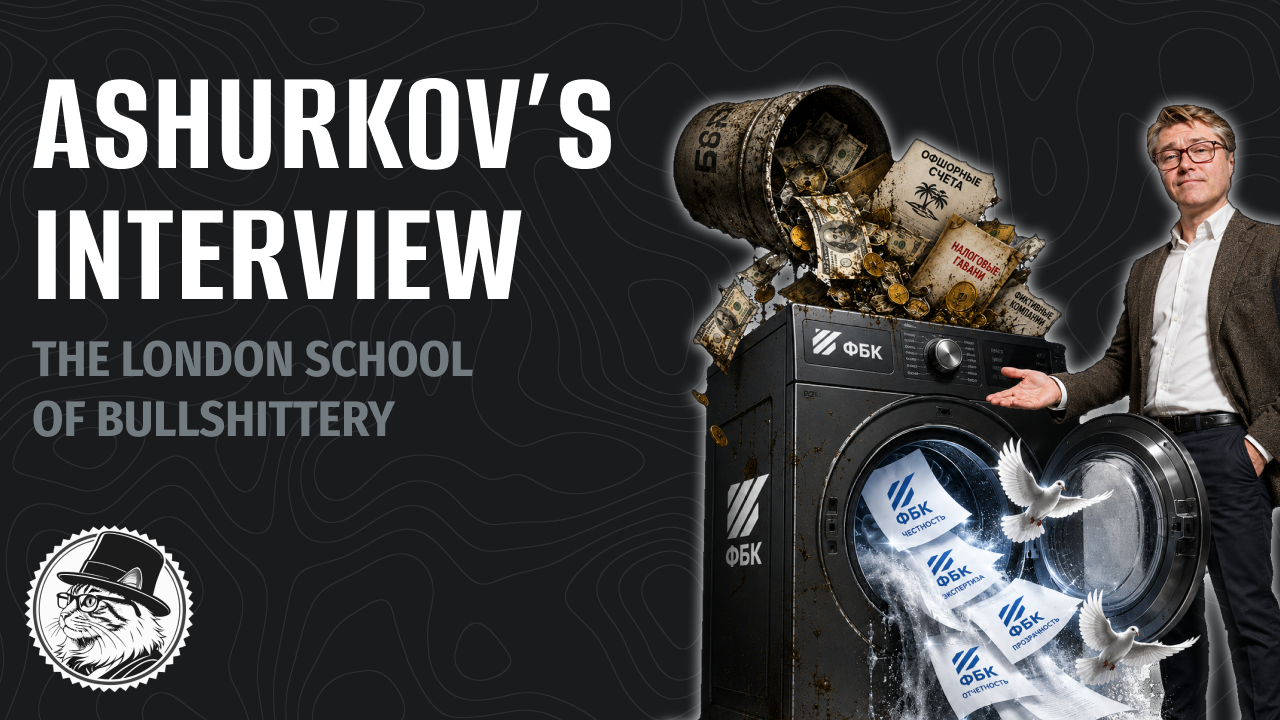
You didn’t ask, but here I am again — talking about Ashurkov.
He gave an interview to Yuri Dud and, once again, rolled out the same legend: Probusinessbank’s management was behind the «Navalny Card» project, the security services came down on them, they got scared and pulled the plug. Sounds neat. Shame it’s bullshit.
I’ve picked apart this story before — in Ashurkov’s affidavit, in the Solodkiy post, in Zheleznyakgate. But now there’s an interview where Ashurkov rehashes the old version and adds some details. Some contradict the documents. Some contradict his own sworn testimony in court.
Let’s go through this again. Hopefully for the last time.
For those who haven’t seen it, here’s the short version of what Ashurkov says. «The Navalny Card» was conceived by Probusinessbank’s management; the project was shut down under pressure from the security services. The bank’s collapse in 2015 was political retaliation for supporting the opposition. The 2017 letter was requested by Leontiev solely for his US asylum case — not a word of falsehood in it. Zheleznyak was hired in 2021 as a humble volunteer treasurer; nobody knew about his past until 2023. He was never summoned to the Liechtenstein court — «that’s a lie.»
Now let’s look at the documents.
The 2017 Myth
Ashurkov says: the card idea came from Probusinessbank’s management. Not true. The idea was brought in by a marketing guy, Vyacheslav Solodkiy, on his own initiative. Not management — just one SMM guy running on pure enthusiasm.
Eduard Panteleev, who headed Bank24 (the PBB-group bank where Solodkiy worked), testified: he personally rejected the project. His wording: «unacceptability of supporting political views of any kind.» The bank had no use for this freelancing.
Kira Yarmysh, Navalny’s press secretary, said it plainly back in 2019:
«In 2012, FBK worked with the management of Bank24.ru on a project to issue a cashback card, with proceeds going to FBK. The bank subsequently abandoned the project. Leontiev and his structures did not finance the foundation or any investigations.»
On May 15, 2012 — the day of the announcement — GQ reported on the Life group’s involvement. Zheleznyak, the bank’s top executive, immediately stated: he knew nothing about the project, the shareholders had no intention of tying the bank to politics, reputational risks were unacceptable. Earlier that same day, Solodkiy put out his own denial.
Ashurkov now spins this as «deliberate falsehoods under FSB pressure.» But all available facts point to one thing: Zheleznyak and Leontiev genuinely had nothing to do with the project and would never have approved this freelancing. It’s the only true thing the bankers ever said — one that, five years later, became convenient to rewrite.
In the interview, Ashurkov insists he met Leontiev personally in the spring of 2012, during the card preparations:
«Interestingly, it was then that I met the main owner of Probusinessbank, Sergey Leontiev. And Navalny even spoke at a kind of strategy session for this banking group — I think it was April or May 2012.»
And five years later, explaining the 2017 affidavit, he adds:
«And in 2017, Sergey Leontiev approached me. I’d seen him before, maybe once, during the preparations for this card project.»
Except Solodkiy himself gave him away. In his own post, Solodkiy writes that he met Zheleznyak and Leontiev only in September 2012. And the project, let me remind you, was publicly disavowed six months before that.
If the person from the bank’s side — the one who came up with the idea of linking up with FBK — first laid eyes on its owners in the autumn, Ashurkov physically could not have discussed the project with Leontiev in April or May. Probusinessbank’s owners learned about their subsidiary’s project from news headlines.
The timeline doesn’t add up. The story about close cooperation between FBK and PBB’s owners in 2012 was fabricated retroactively in the summer of 2017. And there’s proof in Solodkiy’s own letters — he was pitching a tearful persecution story to every journalist he could find, a story that, as of spring 2017, didn’t feature Navalny at all.
Speaking of other bankers. In the same affidavit, Ashurkov writes that Alexander Lebedev (NRB) also backed out of the card, scared of the authorities. Here’s what Lebedev himself said in late May 2012 — in the same survey where Zheleznyak denied PBB’s involvement:
«We expressed interest in issuing co-branded cards through National Reserve Bank, but I don’t have a formal proposal yet. We discussed the situation in principle: they asked me preliminarily how I’d feel about it, and I asked them to show me how well thought-out it was. If these cards help popularize the fight against corruption, that would be good for civil society. As I understand it, the project was initially done with another bank, and then something stalled. I see no political risks, since supporting Navalny’s foundation means supporting Putin’s and Medvedev’s anti-corruption efforts.»
Lebedev wasn’t scared. He publicly confirmed his interest in the project and said he saw no political risks. Ashurkov is lying.
The «Solidarity» Paradox
If the stillborn «Navalny Card» had truly landed the Life group on a blacklist — they would never have been allowed to rehabilitate Bank Solidarity. Yet that’s exactly what happened.
In December 2013, it emerged that Probusinessbank would most likely become the receiver for Solidarity.
February 2014. Elvira Nabiullina is conducting a massive cleanup of the banking sector — 86 licenses revoked that year. And in the middle of this, the Central Bank appoints Probusinessbank as the receiver for Samara-based Bank Solidarity. The bailout comes with a 6-billion-ruble state loan.
Late August 2014: the Central Bank revokes Bank24.ru’s license — the very bank Ashurkov keeps bringing up. The reason? Violations of 115-FZ — anti-money laundering legislation, something Zheleznyak himself had a hand in. Insufficient compliance, not politics. The bank had no balance-sheet hole because Panteleev was running it. This was one of those rare cases where a popular bank with high customer trust lost its license while leaving no debts behind.
In his public statements in April 2015, Leontiev openly admitted that Bank24.ru had essentially «not balanced properly» between regulations and customer convenience, and that they’d since tightened up compliance. In the same interview, Leontiev emphasized that the Central Bank entrusted the Life group with the Solidarity rehabilitation because the trust was well-earned. What he didn’t mention was that Probusinessbank went into that rehabilitation with a massive balance-sheet hole — so that just months after Probusinessbank’s own license was revoked, Solidarity’s rehabilitation had to be done over from scratch, and the bailout money was never returned.
The Affidavit and the Courts
Let’s jump to late May 2017: Liechtenstein authorities freeze the accounts of three of Sergey Leontiev’s companies — Wonderworks, Holdco, Southpac Trust. Suspected of laundering hundreds of millions of dollars siphoned from Probusinessbank.
On July 26, 2017 — two months after the freeze — Ashurkov drafts an affidavit during his trip to the US, arranged by Natalia Arno. October 2017: Leontiev’s defense is already using it in Liechtenstein, demanding the money be unfrozen on the grounds of «political persecution.» I detailed this document here.
Ashurkov used his status as FBK’s Executive Director to convince the courts: the criminal prosecution of the bankers and PBB’s bankruptcy were supposedly Kremlin revenge for supporting the opposition. (The Importance of Ashurkov’s Affidavit) The fabricated political shield worked: Leontiev got the money unfrozen and has since been actively blocking the embezzlement case from being heard on its merits.
The Liechtenstein court directly cited the «political motivation» — gleaned from Ashurkov’s words — and terminated the preliminary money-laundering investigation. Justice never got to the stolen assets. It tripped over an extradition that nobody ever talked about.
In the interview, Ashurkov builds three lines of defense: the letter was only for US asylum; the letter was pure truth; he didn’t know about the defrauded depositors. All three are false.
US asylum was a lawyer’s recommendation. Leontiev didn’t even need it: Cyprus citizenship (EU, legal residence in Europe), an L1 work visa for the US, his own American companies. In an FT podcast, he said it himself:
«The lawyers told me: look, an L1 visa and things like that — that’s not the weapon you need against these guys. They’ve got tanks, you’ve got a pistol. You need to switch weapons.»
«Switch weapons» — obtain political refugee status. Not to save his life. To protect stolen assets in court.
About «I didn’t know about the depositors.» It was impossible not to know. The Probusinessbank case is one of Russia’s biggest financial scandals. By March 2017, the DIA had published reports on a hole of 69.8 billion rubles. Vedomosti, Kommersant, RBC, Forbes — dozens of articles detailing asset-stripping schemes: offshore entities Vermenda, Ambika, shell companies, brokers Dinosaur Merchant Bank, Otkritie, BCS (see the Zheleznyakgate header). Ashurkov is a former top manager at Alfa-Group, a financial expert with an annual income of a million dollars. He drafts an official affidavit in defense of the bank’s owners — and «knew nothing» about billions vanishing from that same bank?
Impossible.
How It Worked: Poland and Switzerland
In 2019, the affidavit traveled to Poland — where the extradition of former PBB Vice President Yaroslav Alekseev was being decided. The Polish court refused extradition, essentially not because of the «Navalny Card» but because Alekseev is a Jehovah’s Witness. And Russia banned that organization.
Genuine Jehovah’s Witnesses, following their faith, do not participate in political life — they don’t even vote. Accordingly, as a Jehovah’s Witness, Alekseev cannot support Navalny.
Ashurkov’s claims about the «political nature» of the case were simply tacked on top. For extra credibility.
Now — his sworn testimony in the Polish court. Minutes of the Katowice Court of Appeal, July 9, 2019. Pay attention: here he’s not just talking about the Navalny Card — he’s openly flaunting his financial expertise. The very same expertise he now denies:
«Based on my experience in the financial and banking sector, knowing the positions Yaroslav Alekseev held, I believed he was a key member of the Life banking group.»
«I think that at some point, raiders, in cooperation with the leadership of the Central Bank, decided to attack the Life group. […] I think it was more a combination of these two elements.»
«Based on my experience in the financial and banking sector» — under oath, in 2019. And now, in the interview: «I don’t understand finance.»
Getting tired yet? Hang in there.
An extradition ruling is an assessment of persecution risks: religious, political. It has nothing to do with frozen assets of unclear origin. So what do Leontiev’s lawyers do? They take the Polish extradition ruling and haul it to Liechtenstein. After several unsuccessful attempts to prove the legality of the money (transactions, fictitious loans, offshore chains) — with lawyers in Cyprus and Austria from Kobre & Kim, the firm that services Abramovich — the defense used the Polish court ruling and Ashurkov’s status as a political shield. And it worked. The judge, violating jurisdictional boundaries, ruled: if the Poles deemed the case political — so be it. Financial transactions? Nothing to see here, move along.
Ashurkov publicly urges everyone to «wait for the court» — while having personally helped the bankers swap out the very subject of the proceedings. An extradition ruling was passed off as an indulgence from financial crimes.
The same Yaroslav Alekseev, under the protection of Leontiev’s lawyers, played the same card in Switzerland. In January 2020, a private bank in Geneva detected suspicious inflows to his accounts — cash and transfers from an offshore firm. The Zurich prosecutor’s office froze over a million francs.
For his defense, Alekseev (or rather, Leontiev, obviously) hired Thomas Borer — former Swiss ambassador to Berlin, consultant to Vekselberg, ex-board member of Renova. Borer launched the scheme: Alekseev is a Navalny supporter, Moscow is persecuting him politically. «Switzerland is persecuting Navalny supporters.»
Then came mini-Liechtenstein. US congressmen — Republican Michael Waltz and two Democrats — sent letters to the Swiss ambassador demanding they «review the Alekseev case» and protect Switzerland from «malefactors» who «seek to abuse the Swiss legal system to attack Navalny supporters.» A debate erupted in parliament; lawmakers demanded comments from the government.
This triggered a major internal political scandal in Switzerland — but FBK won’t tell you about it.
Tagesanzeiger conducted its own investigation and found no evidence that Alekseev was actually an active Navalny supporter. No media footprint, no statements. The only link — that failed «Navalny Card» from 2012.
Lobbying at this level — Borer, congressmen, parliamentary inquiries — probably cost more than the frozen million. But that’s not an expense. It’s a dry run for the scheme and protection for someone who could turn you in. Yaroslav Alekseev, by latest accounts, moved back to Katowice in 2021.
«I Never Received Any Summons»
Ashurkov, categorically:
«That’s a lie. I never received any summons… They would have had no effect and would have carried no weight in the judge’s eyes…»
Liechtenstein court records say otherwise. The hearing minutes from January 9, 2024: Leontiev’s and HoldCo’s defense formally requested to question Vladimir Ashurkov. Verbatim: «Witness Vladimir Ashurkov will be able to prove the true background of the allegations made against Respondent 1 [Leontiev].» The exact wording Ashurkov calls «a lie» in the interview.
Ashurkov uses a trick: «I never traveled anywhere.» He didn’t need to. The record shows: the court approved questioning at his place of residence — «He is in London and will be questioned there.» Remote testimony is not «never traveled anywhere.» It’s an official procedure.
And the key point. Ashurkov’s claim that his testimony «would have carried no weight» is demolished by the trial timeline, where his testimony was pivotal. Leontiev included hours of Ashurkov’s questioning in the cost estimate and demanded from the plaintiffs — the defrauded creditors — a security payment: over 432,000 Swiss francs. For just a 2-hour London deposition, they budgeted 8,140 francs. In other words, depositors would have had to pay out of their own pockets for the right to sue Leontiev. And listen to Ashurkov.
In January 2025, after Maxim Katz’s investigation came out, Leontiev’s lawyers threw a fit. Motions were filed to close the hearings to the public (Nerses files). The reason: Katz’s video, where «witnesses are fiercely condemned for their testimony… in particular, witness Vladimir Ashurkov.» The lawyers asked to protect Ashurkov’s and other non-public witnesses’ reputations from the media. There were no other witnesses, of course — only written statements from way back in 2018, arranged by Dubograev and Kobre & Kim.
So Ashurkov is formally listed as a witness by Leontiev’s side. Deposition in the court plan and budget. When this became public — the defense tried to seal the proceedings. «I never received any summons» — false.
One more detail: in the same affidavit, Ashurkov hid behind banker Lebedev. He stated under oath that Lebedev backed out of the card under Central Bank pressure, that the Central Bank imposed higher reserve requirements on his bank, and that Lebedev personally confirmed to him the political motivation behind these decisions.
«Among the businessmen who donated funds to fight corruption was Alexander Lebedev, and earlier Alexey Savchenko, who owned National Reserve Bank in Russia. We worked closely with Alexander Lebedev. He supported the fight against corruption, which was my job and Navalny’s job.» «When the debit card project fell through, we started discussing issuing such cards through his bank — National Reserve Bank. Subsequently, when we developed the project for issuing cards through Reserve Bank, Alexander Lebedev abandoned the idea because he feared his bank would come under pressure and he might lose it.» «Even though our project with National Reserve Bank fell through, the regulator, i.e. the Central Bank, exerted very strong pressure on this bank. The Central Bank, as regulator, ordered stricter rules for its banking activities. This involved imposing higher reserves compared to other banks.» «As a result, National Reserve Bank was forced to drastically scale back its operations, and its profit plummeted catastrophically.» «In 2013 and 2014, I had several meetings with Alexander Lebedev, and he told me about his relations with the Central Bank and the decisions taken by that bank regarding his bank. He confirmed that this was motivated by his independent activities and support for the fight against corruption.»
Lebedev has never, anywhere, mentioned anything of the sort. More than that — he said the exact opposite.
Asset Tracing for Money, «I’m No Expert» for Free
When it comes to evidence of money being siphoned from Probusinessbank, Ashurkov switches to «I’m no expert» mode:
«Complex things, like a bank’s financial operations, can’t be reduced to some kind of schemes… I won’t comment on things I don’t fully understand… I definitely wouldn’t take that on.»
In the same interview, he mentions: he owns a London-based company, Zorge Partners Limited. He created it in 2020 with Nikita Kulachenkov — who spent years in FBK’s investigations department before going private. Ashurkov offered him a partnership: «corporate private investigations.»
How it works. Two businessmen with Russian connections are litigating in a Western court. They need dirt on each other. Zorge Partners «combs through corporate registries, property registries, social media,» compiles a dossier, and hands it to the lawyers. Classic: a high-net-worth divorce. The husband hides assets — Zorge finds them for the wife. This is called asset tracing. Hourly billing, like lawyers.
Zorge Partners’ website specifies: the firm specializes in deep investigations, uncovering hidden risks, and «exposing financial wrongdoing.»
For money, Zorge Partners untangles offshore chains, finds hidden assets, conducts due diligence, and exposes schemes for courts in London and the US. But when it comes to FBK’s «sponsors» — Leontiev and Zheleznyak, who siphoned hundreds of millions through fictitious loans to offshore entities Vermenda, Ambika, Merrianol — «expert» Ashurkov suddenly loses his qualifications. The theft is «too complex a scheme,» he «wouldn’t take that on,» let’s «wait for the court.»
A man whose business is asset tracing and exposing financial crimes understands perfectly well what happened at Probusinessbank. He investigates other people’s schemes for a fee. But on the stolen billion — he averts his eyes. These thieves built FBK’s financial infrastructure in the US.
Infrastructure, Prison Sentences, and «Mistakes»
In the interview, Ashurkov paints a picture: Zheleznyak was a humble volunteer, did technical work, nobody knew about his past until 2023. The documents show otherwise.
Zheleznyak didn’t create any legal entity from scratch. FBK took a ready-made firm, Rikolto Ltd (registered by foundation supporter Kirill Moizik) and renamed it Anti-Corruption Foundation Inc. (Zheleznyakgate. Part One)
Pro bono? The foundation’s US tax filings: 2021 — $6,975 on accounting and legal services; 2022 — $46,691. The foundation paid.
Not just a treasurer. Public US registries: Alexander Zheleznyak is not only Treasurer, but Vice President and Principal Officer of the American FBK (and there was a period when Alexander Lomov — the guy who drew up reports for the Central Bank — was President and Vice President, before Navalny even announced the opening of «International FBK»).
And Zheleznyak exercised his authority: he signed consent on behalf of FBK to create the lobbying entity Anti-Corruption Foundation USA in Virginia. In October 2022, under Vice President Zheleznyak’s signature, a letter went out for a $20,000 grant to the NGO RADR (where Zheleznyak himself was the Boston coordinator) — for meetings with FBK leadership in the US.
To protect the siphoned hundreds of millions, the bankers needed to prove to the West: we are prominent opposition figures. Multiple commissioned articles and interviews. Notably, Leontiev’s interview with the Austrian magazine profil: «My partner Alexander is a director in Navalny’s US organization» («Mein Partner Alexander ist ein Direktor in Nawalnys US-Organisation»). This is the very political cover that FBK provided the bankers.
Ashurkov says: in 2021 there was no time for due diligence, they realized the mistake in 2023. But Probusinessbank’s collapse and the theft of nearly a billion dollars have been a scandal since 2015. Vedomosti, RBC, Kommersant, Forbes wrote about it for years. FBK’s leadership couldn’t not have known.
Moreover: in 2020, Andrey Zayakin, co-founder of Dissernet and an investigator who collaborated with FBK, conducted hours of interviews with Zheleznyak and Leontiev. He studied the documents. He discovered: the bankers’ infrastructure was used for laundering hundreds of millions from the prosecutor’s slush fund. Roman Dobrokhotov says: the money-laundering materials were handed to FBK no later than spring 2024. The response — nothing.
FBK knew who they were dealing with. They turned a blind eye, consciously. Leontiev, according to Volkov, was transferring at least $240,000 a year to the foundation’s structures.
Zheleznyak brought his own people into the foundation’s American infrastructure. The legal entities were created by Dmitry Dubograev — an American lawyer of Belarusian origin whose firms serviced companies that made software for Russian security forces and facial recognition systems for the Lukashenko regime: «Synesis» and Oxygen Forensics. Zheleznyak’s personal assistant Evgenia Kvitman, who manages his trusts, became a secretary in ACF’s structures.
Stripe and Real Prison Sentences
In the interview, Ashurkov himself explained why they hired Zheleznyak:
«In 2021, FBK was designated an extremist organization. We had to rebuild our entire financial infrastructure… The most convenient way to collect money is through the Stripe system… Lyonya told me: ‘Here’s the new person who will handle this — Alexander Zheleznyak.’»
Zheleznyak opened accounts in the US and managed them. Donations via Stripe went to the American non-profit, and from there to Lithuania. This «financial infrastructure» resulted in criminal cases for hundreds of people.
On August 5, 2021, Leonid Volkov and Ivan Zhdanov publicly urged Russians to switch to Stripe: the foundation had left the Russian financial system, donations could now be made «completely anonymous and safe.»
The «safe ecosystem» turned out to be full of holes. Russian banks — Sberbank in particular — could see where the payments were going. The statements showed the point of service name: «THANKS, WORLD.FBK.IN US» with a unique merchant ID. The security services got a ready-made database. (SOTA article) (Meduza article) (Meduza analysis)
Real prison sentences. Alexey Malyarevsky — 7 years. Andrey Kovalenko — 5 years. Ivan Tishchenko — 4 years. Hundreds more — pre-trial detention, house arrest, fines.
FBK «became aware» of the problem, but shifted the blame onto Stripe — calling it a technical glitch. A possible solution was simple: return the money to people from the American account. As one convicted donor’s lawyer put it: «FBK could simply have returned the Russians their payments… in that case, one could argue there was ’no event of a crime.’» But they kept the money. People — under criminal charges.
Ashurkov was asked directly: the infrastructure they created turned out to be dangerous, people are in prison. His answer:
«My colleagues handled that, and I think it’s silly for me, in my position, to comment on it now… On the other hand, only those who do nothing make no mistakes.»
FBK’s American ecosystem, built by Zheleznyak — who, per Ashurkov, was hired specifically for Stripe and US accounts — gave the banker a political «cover.» Thousands of Russians who trusted the foundation will go to prison.
The Fridman Letter
In the same interview, Ashurkov gave up another episode. FBK’s leadership, in secret from colleagues and supporters, traded the foundation’s political capital in the interests of a Russian oligarch.
After February 24, 2022, Ashurkov decided to build bridges with his former boss at Alfa-Group — Mikhail Fridman. He personally introduced Volkov to Fridman. Several secret meetings in London.
The logic: if sanctions were lifted from Fridman, he «could feel free, speak out against the war, and send some substantial money for humanitarian aid to Ukraine.» First the indulgence — then, maybe, an anti-war stance. Dud demolished this argument with the example of Tinkov: he publicly condemned the war first, sold his business for a pittance, lost his assets in Russia — and even after all that, sat under sanctions for a long time.
From Ashurkov’s words, it’s clear: Volkov signed the letter knowingly and concealed it from Pevchikh, Zhdanov, and the rest. They discussed whether to inform their colleagues. They decided not to. Volkov «took that risk on himself.»
When the secret came out, the letter-signing was called «a mistake.» Volkov publicly promised to step down from leadership roles. Navalny announced that Volkov was moving to other positions. Ashurkov defends him with the same phrase he used for the donors in prison: «Only those who do nothing make no mistakes.»
No conclusions here.
Article updated May 13, 2026 at 01:25: «The Solidarity Paradox» section added with sources.